How to sort building bricks: a system that actually sticks
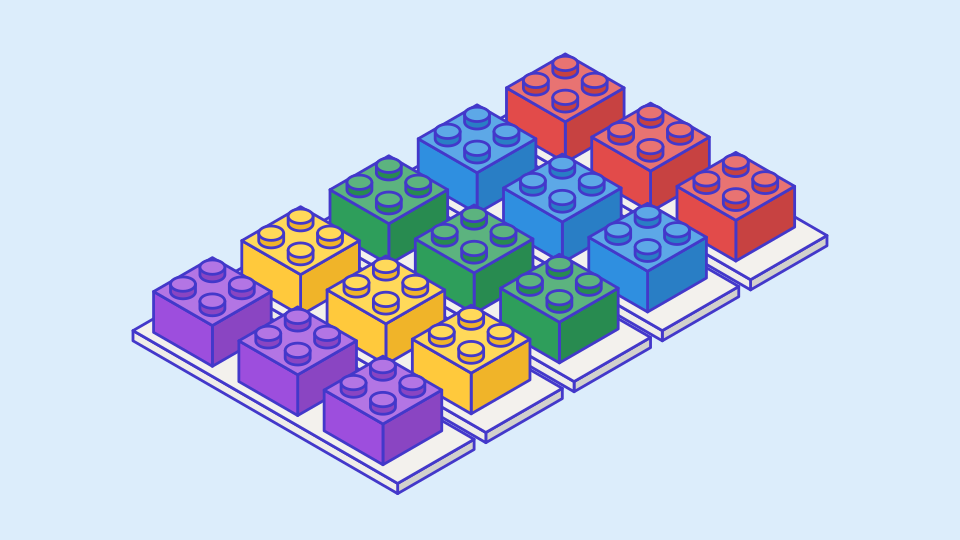
Every brick box reaches the point where searching takes longer than building. You need one grey 1×2 plate and dig for five minutes. Sorting helps – but only if the system fits your stock and survives the big clean-up. Most attempts fail not for lack of effort but because of three mistakes: sorting by colour too early, creating too many compartments, and having no place for "not sorted yet".
Why sorting by colour fails
Colour is the first thing you see and the last thing you should sort by. In a box of 400 red parts you still hunt for a specific piece with your eyes: a 1×2 plate, a 1×2 brick and a 1×2 tile look just as alike in red as they do in the mixed pile. Sorted by shape, you reach into the "plates 1×2" tray and only have to find the colour – among 30 parts instead of 400.
Then there is the logic of building. Every parts box in a set of instructions names the shape first and the colour second: "plate 1×4, blue, 2 pieces". A storage system built the same way can be worked through with the instructions in hand. The parts list from the editor is grouped by part type too.
The exception: when one part type is so plentiful that a tray overflows – as a rule of thumb, from about 200 pieces of the same type – colour becomes the second level. That happens quickly with 1×1 plates or 2×4 bricks and almost never with slopes.
The four levels
- Roughly by size. Anything longer than four studs goes in one box, baseplates go on a shelf. The rest stays in the pile. This step is fast because big parts can be fished out by the handful.
- By part type. Bricks, plates, tiles, slopes, round parts, special parts. Six containers, no more. What the terms mean is explained in the guide Brick, plate, tile, slope.
- By size within the type. First coarse: narrow parts (1×n) and wide parts (2×n and larger). Then fine: 1×1 and 1×2 get their own small compartments, because they are used most and lost most easily. Long parts like 1×8 or 2×8 sit together.
- By colour only where things overflow. A tray "bricks 2×4" eventually becomes "2×4 red", "2×4 white" and "2×4 other".
The order matters: level 3 starts only once level 2 is finished for the whole pile. If you sort by type, size and colour at the same time, after an hour you have 40 half-filled bowls on the floor and no overview.
Which system fits which quantity
| Stock | Containers | Sorting |
|---|---|---|
| up to 500 parts | one box and a flat tray to spread parts out | none – the tray replaces searching |
| 500 to 2,000 parts | six boxes or one organiser with six large compartments | by part type |
| 2,000 to 10,000 parts | organisers with adjustable dividers, 20 to 40 compartments | part type and size |
| over 10,000 parts | drawer cabinet, one drawer per part type and size | part type, size and main colours |
You do not have to count. A litre (roughly a quart) of mixed bricks holds about 150 to 250 parts, so a 10-litre box sits somewhere between 1,500 and 2,500 pieces.
The right containers
- Adjustable dividers. Fixed grids never fit; after the next birthday the 2×4 tray needs twice the space.
- Clear, with a lid. You can see what is inside and stack the boxes. Label them anyway – part name plus a small sketch, so children who cannot read yet can still put parts back.
- Small compartments for small parts. Putting 1×1 bricks and 1×1 plates into a big compartment means sweeping them up from its floor later. Screw organisers from the hardware shop have the right compartment size.
- Store flat what scratches. Tiles and transparent parts get their own compartments; otherwise they rub against studs and go dull.
- One box labelled "to sort". The most important container in the system. Everything that comes off a dismantled model goes in there – not into storage. Storage stays clean, and sorting has a fixed home.
Sort in 20-minute sessions
A whole afternoon in one go is the surest way to stop halfway. Better: fixed 20-minute sessions, two or three times a week. One session looks like this:
- Pour a handful from the box onto a flat tray or a baking sheet – not onto the carpet, where the 1×1 parts vanish.
- Pull out everything big first.
- Then pick out the part type that appears most often on the tray. One type at a time, not all at once – the eye finds a shape far faster when it is looking for only that shape.
- Rest goes back into the "to sort" box, next handful.
That way one session clears roughly 300 to 500 parts. A 10-litre box is done in five to eight sessions, with an audiobook on in the background.
With children it turns into a game: each child is assigned one part type and collects only that. Whoever reaches ten pieces first calls out. This works from about age five, and the children learn the names of the parts on the side.
Keeping it tidy after a teardown
The best system is worthless after three months if every teardown ends up in storage. Three habits are enough:
- Dismantled parts go into the "to sort" box, never straight into the compartments. Putting parts back is its own session.
- Go through the parts list before you build. Export it from the editor as CSV, lay every part out in a bowl, and only then start. You spot what is missing right away instead of searching halfway through the model.
- Replace missing parts in the plan. No blue 2×4 bricks left? Recolour them in the editor with the paint tool or swap each for two 2×2 bricks – the instructions adapt.
Plan first, then reach
A sorted stock pays off most when you build from a plan: read the parts box, reach into the right tray, place the brick. Build your next model in the editor, export the parts list and lay the parts out before you place the first brick.